

Published date: 1st of August, 2025
The world is buzzing with excitement around AI agents. From autonomous copilots to AI assistants that manage entire workflows, the possibilities feel limitless. But what often remains unseen is the staggering complexity behind building and deploying these agents.
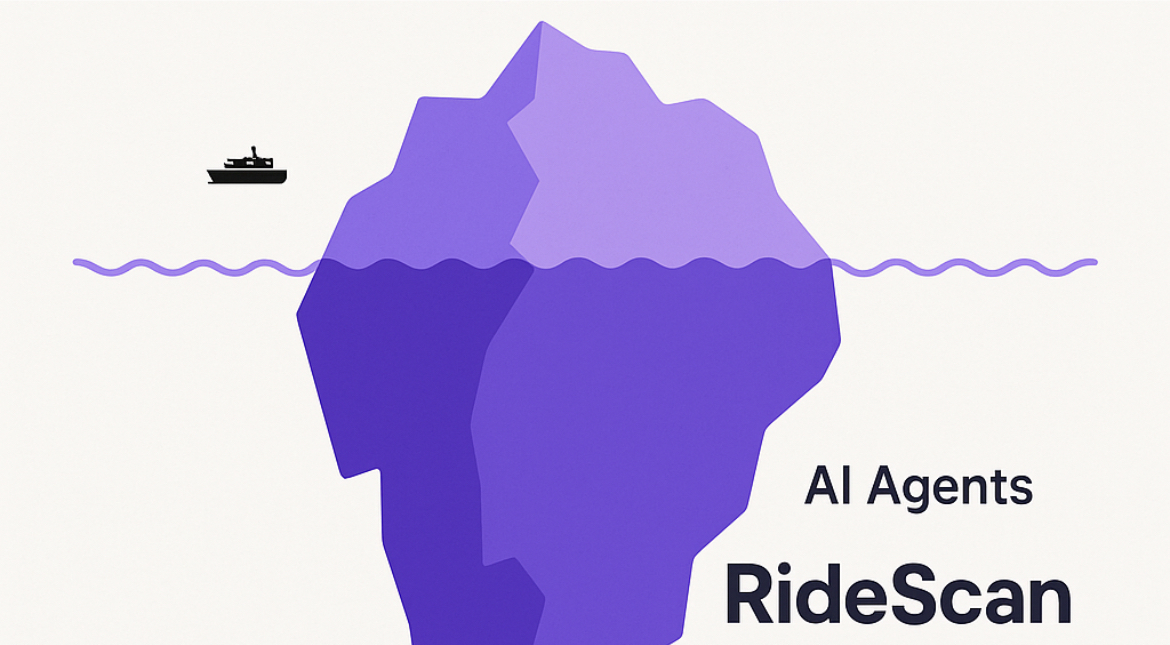
This iceberg visual captures it perfectly.

At the tip of the iceberg, we see polished interfaces like Bolt, Devin, Cognigy, Glean, and Harvey. They look seamless on the surface. But behind the scenes, these agents depend on a vast and layered infrastructure—memory layers, authentication systems, orchestration logic, observability tools, foundational models, routing, databases, and more.
Most of the real innovation lies below the surface. And this is precisely where RideScan fits.
While others focus on building and deploying AI agents, RideScan operates in the depths of the infrastructure stack. We are developing a foundational model architecture, not for language or vision, but for robotic behavior itself.
These models are trained to understand what optimal execution looks like across a wide range of robotic systems, missions, and environments. Just as OpenAI built foundational models for language, we’re building foundational intelligence for assessing robotic performance and detecting subtle anomalies that agents themselves can’t see.
This means RideScan is not just another analytics tool. It’s an evolving intelligence layer, one that learns from execution data across robots, captures hidden failure patterns, and provides independent judgment on how well a task was truly performed.
RideScan provides independent insight into AI execution. We don’t rely on the robot’s self-reported success. Instead, we look at how the task was actually performed, even if the robot thinks everything went fine. When an agent grabs a table instead of a box, when power usage unexpectedly spikes, or when mechanical wear begins to show, RideScan detects these hidden anomalies that would otherwise go unnoticed.
This is critical in industrial automation, humanoid robotics, drones, and beyond. As AI agents move from screens to the real world, we need to ensure they act not just intelligently, but reliably.
That’s what RideScan is built for.
We are proud to be part of this evolving stack of AI agent infrastructure. Our technology helps close the loop, from decision to action to accountability. While others enable autonomy, we enable trust in autonomy.
If you're building, investing in, or deploying AI agents in the physical world, it’s time to look beneath the surface.Because what you don’t measure, you can’t improve. And what you don’t see, you can’t trust.


